
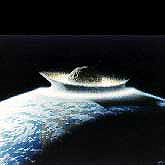
 Recently, some astronomers
were concerned that a newly discovered asteroid might hit Earth in
2017. This was big news because even the impact of a modest-sized
asteroid could have a devastating effect. In fact, a large impact 65
million years ago is thought to have wiped out the dinosaurs. So
scientists take seriously any potential asteroid impact with the Earth.
A few days after the discovery, scientists changed their minds and said
there was no need to panic. This particular asteroid was not going to
come even close.
Recently, some astronomers
were concerned that a newly discovered asteroid might hit Earth in
2017. This was big news because even the impact of a modest-sized
asteroid could have a devastating effect. In fact, a large impact 65
million years ago is thought to have wiped out the dinosaurs. So
scientists take seriously any potential asteroid impact with the Earth.
A few days after the discovery, scientists changed their minds and said
there was no need to panic. This particular asteroid was not going to
come even close.If you go back over the last few years, you'll see this same thing repeatedly: first, a possible collision; next, a retraction. So what gives? Were the calculations all wrong? Actually not. In most cases it had to do with recalculations based on pre-discovery images of the asteroid. In effect, scientists looked backwards in time to make a better prediction about the future.
Astronomers
use computers to take multiple pictures of the same part of the night
sky over time. These pictures are compared. If a point of light appears
to have changed position, we know that it is moving very fast. The
background stars, since they are so much farther away, don't appear to
move over a short period of time. But these initial pictures don't tell
scientists too much. Instead, now that they know what they've found and
where they've found it, they can go back to historical images of the
same section of sky, taken all over the world. With careful
examination, they can find the same asteroid in earlier pictures. This
helps them come up with a much more accurate prediction of the
asteroid's path. So far, no one has predicted an asteroid impact with
Earth. And we are very thankful for that.
