
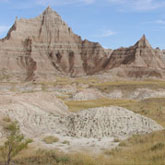
 The bizarre landforms called
badlands are, despite the uninviting name, a masterpiece of water and
wind sculpture. They are near deserts of a special kind, where rain is
infrequent, the bare rocks are poorly consolidated and relatively
uniform in their resistance to erosion, and runoff water washes away
large amounts of sediment. On average, the White River Badlands of
South Dakota erode one inch per year. They are formidable redoubts of
stark beauty where the delicate balance between creation and decay,
that distinguishes so much geologic art, is manifested in improbable
landscapes - near moonscapes - whose individual elements seem to defy
gravity. Erosion is so rapid that the landforms can change perceptibly
overnight as a result of a single thunderstorm. At Badlands National
Park, weird shapes are etched into a plateau of soft sediments and
volcanic ash, revealing colorful bands of flat-lying strata.
The bizarre landforms called
badlands are, despite the uninviting name, a masterpiece of water and
wind sculpture. They are near deserts of a special kind, where rain is
infrequent, the bare rocks are poorly consolidated and relatively
uniform in their resistance to erosion, and runoff water washes away
large amounts of sediment. On average, the White River Badlands of
South Dakota erode one inch per year. They are formidable redoubts of
stark beauty where the delicate balance between creation and decay,
that distinguishes so much geologic art, is manifested in improbable
landscapes - near moonscapes - whose individual elements seem to defy
gravity. Erosion is so rapid that the landforms can change perceptibly
overnight as a result of a single thunderstorm. At Badlands National
Park, weird shapes are etched into a plateau of soft sediments and
volcanic ash, revealing colorful bands of flat-lying strata.The stratification adds immeasurably to the beauty of each scene, binding together all of its diverse parts. Viewed horizontally, individual beds are traceable from pinnacle to pinnacle, mound to mound, ridge to ridge, across the intervening ravines. Viewed from above, the bands curve in and out of the valley like contour lines on a topographic map. A geologic story is written in the rocks of Badlands National Park, every bit as fascinating and colorful as their outward appearance. It is an account of 75 million years of accumulation with intermittent periods of erosion that began when the Rocky Mountains reared up in the West and spread sediments over vast expanses of the plains. The sand, silt, and clay, mixed and interbedded with volcanic ash, stacked up, layer upon flat-lying layer, until the pile was thousands of feet deep. In a final phase of volcanism as the uplift ended, white ash rained from the sky to frost the cake, completing the building stage.
During the Oligocene epoch 40 to 25 million years ago, the region that is now the White River Badlands supported many kinds of animals. The land was then lush, well watered, and much warmer than now. The animals, mostly mammals, roamed the floodplains; many died in floods and were quickly buried in river sediments. Conditions for preservation were excellent; the Oligocene beds are one of the world's richest vertebrate fossil sites, though they represent only a short segment of Earth history.
