
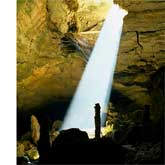
 Cave and karst systems are
important for two major reasons. First, the overwhelming majority of
the nation's freshwater resources is groundwater. About 25% of the
groundwater is located in cave and karst regions. The protection and
management of these vital water resources are critical to public health
and to sustainable economic development. As identified by the National
Geographic Society, water resources are a critical concern as society
enters the twenty-first century. Second, caves are storehouses of
information on natural resources, human history and evolution.
Therefore, many avenues of research can be pursued in caves. Recent
studies indicated that caves contain valuable data that are relevant to
global climate change, waste disposal, groundwater supply and
contamination, petroleum recovery, and biomedical investigations. Caves
also contain data that are pertinent to anthropologic, archaeologic,
geologic, paleontologic, and mineralogic discoveries and resources.
Cave and karst systems are
important for two major reasons. First, the overwhelming majority of
the nation's freshwater resources is groundwater. About 25% of the
groundwater is located in cave and karst regions. The protection and
management of these vital water resources are critical to public health
and to sustainable economic development. As identified by the National
Geographic Society, water resources are a critical concern as society
enters the twenty-first century. Second, caves are storehouses of
information on natural resources, human history and evolution.
Therefore, many avenues of research can be pursued in caves. Recent
studies indicated that caves contain valuable data that are relevant to
global climate change, waste disposal, groundwater supply and
contamination, petroleum recovery, and biomedical investigations. Caves
also contain data that are pertinent to anthropologic, archaeologic,
geologic, paleontologic, and mineralogic discoveries and resources.Many researchers have turned to caves as natural laboratories where over eons paleoclimatic evidence has been naturally deposited and is awaiting discovery. For example, the recently discovered Lechuguilla Cave in New Mexico has excited scientists with the possibilities of gaining insight into global warming from analyses of materials found there. Cave-dwelling organisms have specialized adaptations such as extreme longevity and enhanced sensory perceptions. The adaptations reveal much about the evolutionary responses to past environmental changes and may provide valuable clues to current climate change. Many caves act as natural traps for flora and fauna, and new species of extinct animals such as a mountain goat and a bush oxen related to the present day muskox (Ovibus moschatus) have been discovered from paleoentological excavations in caves. These discoveries add to the knowledge of paleo-fauna and are an aid to understanding changes in the global climate.
Caves have always been known as repositories of archeological material. Historic and prehistoric cultural remains in caves are extraordinarily diverse. They range from ancient torch smudges on cave ceilings to civil war age saltpeter vats used to make gun powder. In spite of this diversity, the cultural resources have common attributes: they are subtle, elusive, or fragile or all three; and they provide unique and valuable information about the past. Without proper documentation and research of these hidden cultural remains in deep or shallow caves, valuable and important segments of the human history would be lost for all time.
