
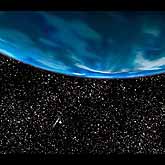
 Long before our Sun and
Earth ever existed, a Jupiter-sized planet formed around a sun-like
star. Now, almost 13 billion years later, NASA's Hubble Space Telescope
has precisely measured the mass of this farthest and oldest known
planet. The ancient planet has had a remarkable history, because it has
wound up in an unlikely, rough neighborhood. It orbits a peculiar pair
of burned-out stars in the crowded core of a globular star cluster. The
new Hubble findings close a decade of speculation and debate as to the
true nature of this ancient world, which takes a century to complete
each orbit. The planet is 2.5 times the mass of Jupiter. Its very
existence provides tantalizing evidence the first planets were formed
rapidly, within a billion years of the Big Bang, leading astronomers to
conclude planets may be very abundant in the universe.
Long before our Sun and
Earth ever existed, a Jupiter-sized planet formed around a sun-like
star. Now, almost 13 billion years later, NASA's Hubble Space Telescope
has precisely measured the mass of this farthest and oldest known
planet. The ancient planet has had a remarkable history, because it has
wound up in an unlikely, rough neighborhood. It orbits a peculiar pair
of burned-out stars in the crowded core of a globular star cluster. The
new Hubble findings close a decade of speculation and debate as to the
true nature of this ancient world, which takes a century to complete
each orbit. The planet is 2.5 times the mass of Jupiter. Its very
existence provides tantalizing evidence the first planets were formed
rapidly, within a billion years of the Big Bang, leading astronomers to
conclude planets may be very abundant in the universe.The planet lies near the core of the ancient globular star cluster M4, located 5,600 light-years away in the northern-summer constellation Scorpius. Globular clusters are deficient in heavier elements, because they formed so early in the universe that heavier elements had not been cooked up in abundance in the nuclear furnaces of stars. Some astronomers have therefore argued that globular clusters cannot contain planets, because planets are often made of such elements. This conclusion was seemingly bolstered in 1999 when Hubble failed to find close-orbiting 'hot Jupiter'-type planets around the stars of the globular cluster 47 Tucanae. Now, it seems astronomers were just looking in the wrong place, and gas-giant worlds, orbiting at greater distances from their stars, could be common in globular clusters.
The
story of this planet's discovery began in 1988, when the pulsar, called
PSR B1620-26, was discovered in M4. It is a neutron star spinning just
under 100 times per second and emitting regular radio pulses like a
lighthouse beam. The white dwarf was quickly found through its effect
on the clock-like pulsar, as the two stars orbited each other twice per
year. Sometime later, astronomers noticed further irregularities in the
pulsar that implied a third object was orbiting the others. This new
object was suspected to be a planet, but it also could have been a
brown dwarf or a low-mass star. Debate over its true identity continued
through the 1990s. A 13-billion year old planet orbiting a pair of
long-dead stars in a crowded globular cluster: even for the Hubble
Space Telescope, that's amazing!
